

Picture this. It’s the morning of January 2nd, 2026.
The Christmas tree is back in the loft. The decorations are down, leaving the living room looking strangely bare. Outside, the sky is that relentless shade of British grey. You are back at your desk, tired, a few pounds heavier than you were in November, and dreading the “Back to Work” email pile up.
Then, your phone buzzes. It’s a notification from your banking app.
It’s the bill for December. The turkey, the presents, the drinks, the travel. It’s all there in black and white.
For 90% of the population, January is a month of defense. We spend 31 days retreating. We cut back on posh coffee. We cancel subscriptions. We feel guilty about the money we spent, and we spend the entire month trying to claw our way back to zero. We are fighting a financial hangover.
I am refusing to do that this year.
I’ve decided that my January 2026 isn’t going to be about defense. It’s going to be about offense.
I don’t want to spend January paying off the past. I want to spend it building the future. I want to end the month not just “back to even,” but significantly up.
The goal is simple: Generate £2,000 in new income by January 31st.
And I’m not going to do it by “hustling harder” or relying on a vague New Year’s Resolution. I’m going to do it by building a System.
The “Resolution” Trap
We need to talk about why most people fail at this.
Every year, millions of people make a resolution to “make more money” or “start a side hustle.” By February 15th, statistically, 80% of them have quit.
Why? Because they relied on motivation, not logistics.
Motivation is a feeling. It vanishes the moment you are tired, or stressed, or busy. Logistics are reliable. Logistics don’t care how you feel.
Think about how a major retailer operates. A shop like Selfridges didn’t plan their Christmas window displays in December. They planned them in July (or earlier!). They didn’t “hope” they would make sales; they built a supply chain, a marketing calendar, and a staffing rota to guarantee it.
Yet, we treat our own lives like amateurs. We wait until the clock strikes midnight on New Year’s Eve and think, “Right, I should probably start a business now.”
That is too late. If you start building in January, you won’t get paid until March.
If you want to be paid in January, you have to build in November.
The “Project January” Operating System
Over the last 7 days, I have been quietly building what I call the Q1 Income Operating System (OS).
I realised that if I wanted to hit that £2,000 target, I couldn’t just “wing it.” I needed a digital headquarters. A place that stripped away the emotion and left only the execution.
I’ve built this in Notion, and I’m going to be releasing it to a small group of people later this month. But for now, I want to show you the “Engine Room.”
Here is what I built this week:
1. The Niche Validator (Stop Guessing)
The number one reason people stay broke is that they fall in love with a bad idea. They spend weeks building a website for a service nobody wants.
I didn’t want to waste time, so I built an AI-powered Validator. It forces you to look at your skills objectively and asks four painful questions: Is it specific? Is it painful? Can they pay? Can I deliver?
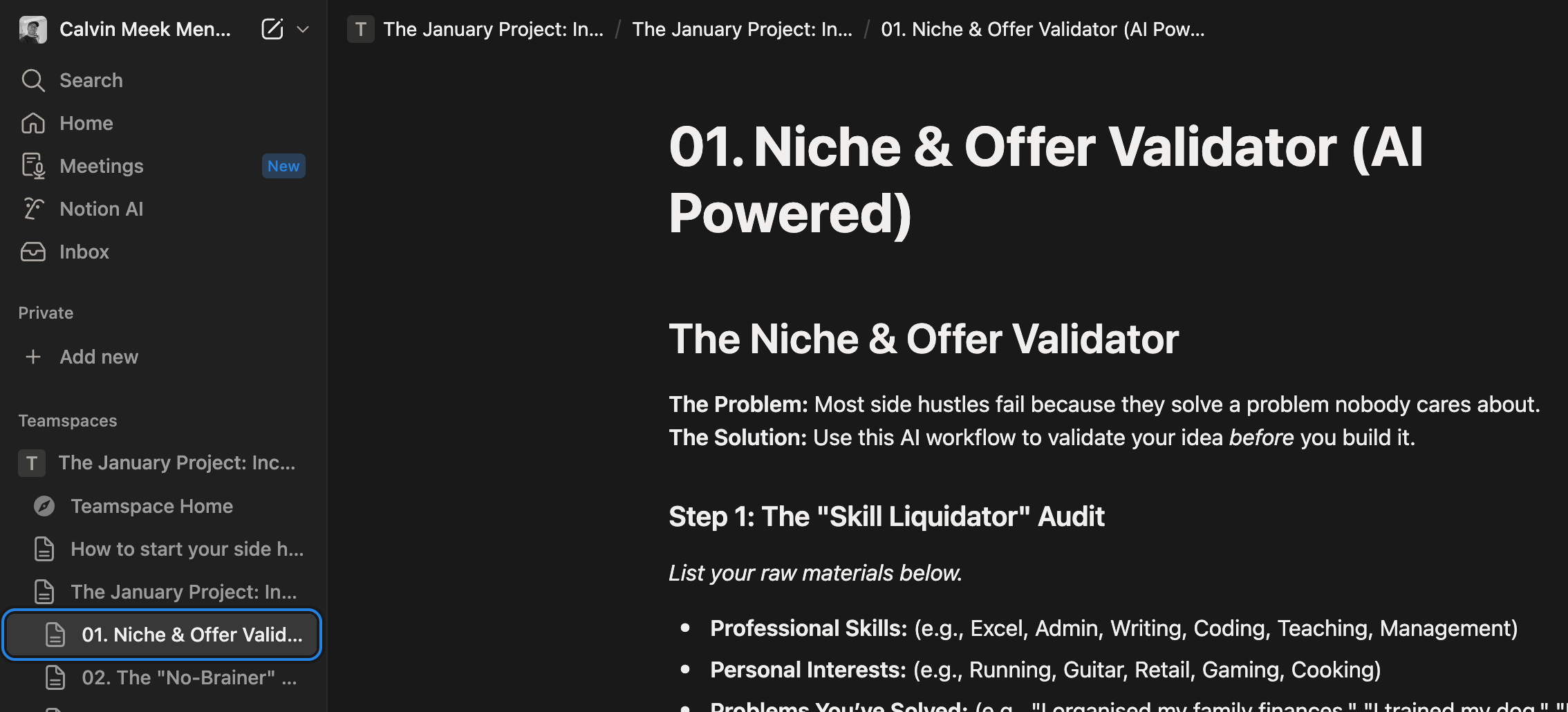
If the idea doesn’t pass the audit, it doesn’t get built. Simple as that.
2. The 30-Day Roadmap (The Sat-Nav)
Anxiety comes from not knowing what to do next. When you wake up and think “I need to make money,” it’s overwhelming.
So, I broke it down. I created a roadmap that tells me exactly what to do every single morning for 30 days.
Day 1: Pick the offer.
Day 5: Build the waitlist.
Day 15: Send 5 emails.
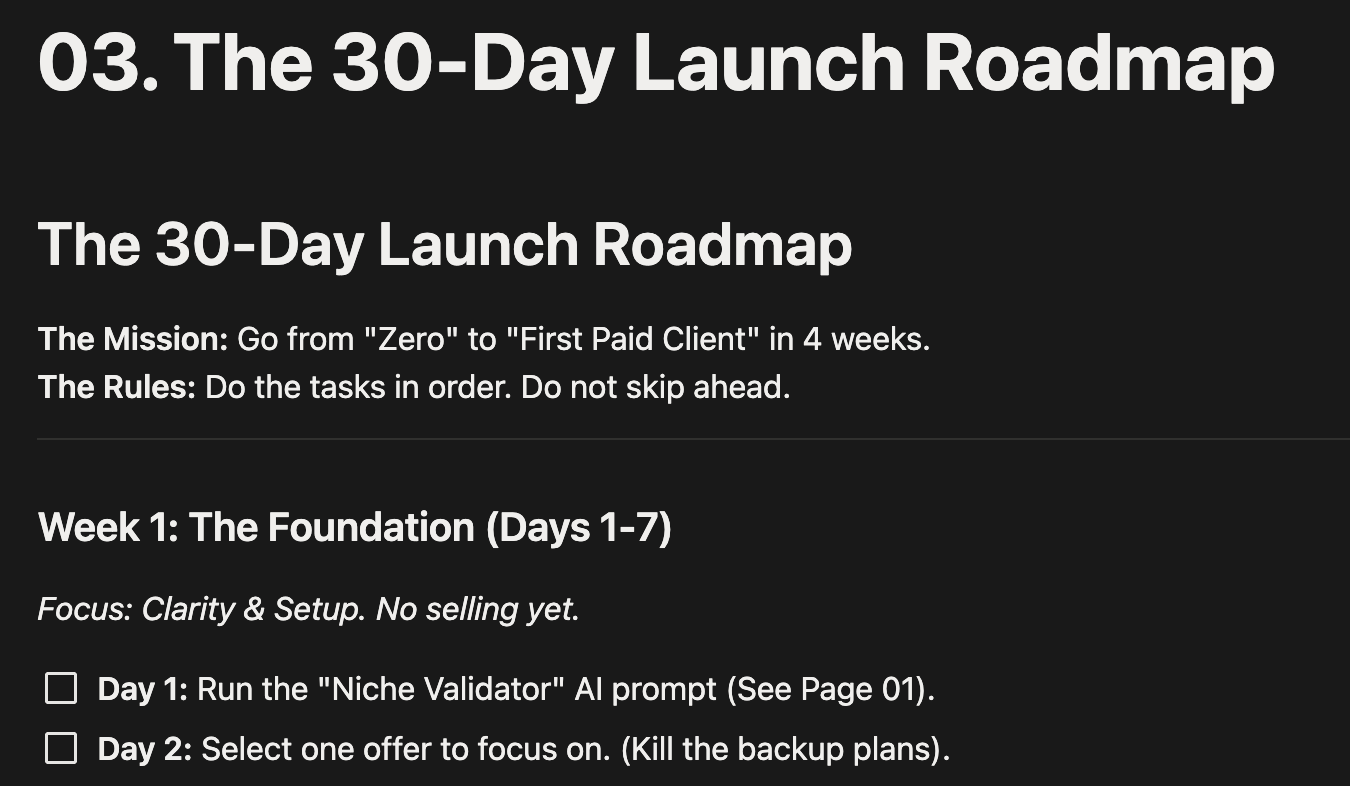
I don’t have to think. I just have to look at the list and tick the box.
3. The Revenue Scoreboard (Gamification)
This is my favourite part. I like spreadsheets, but I love games.
I built a tracker that turns income into a high score. It highlights the “Gap to Goal”. Every time I log a win—even if it’s just a £50 sale—the progress bar moves.
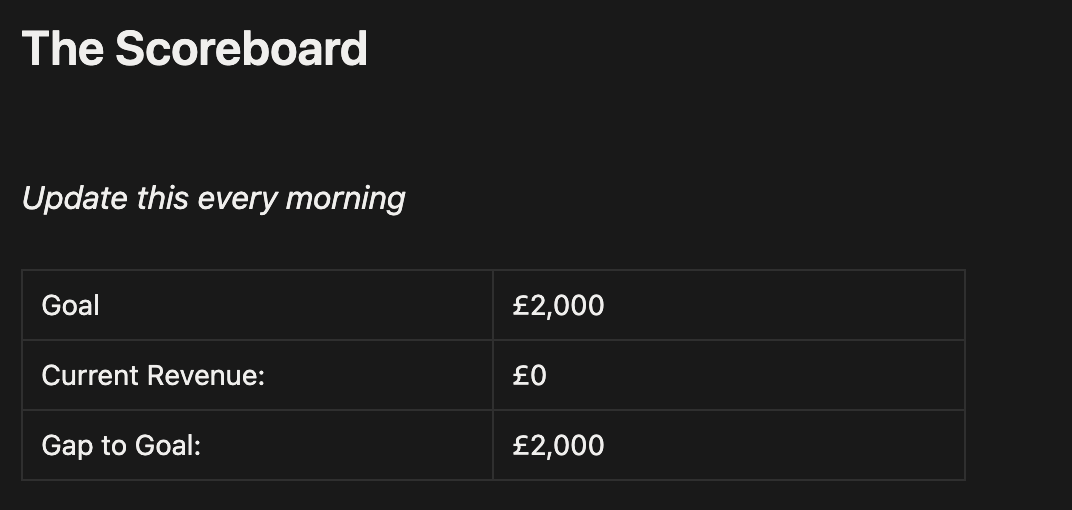
It sounds silly, but seeing that gap decrease releases dopamine. It makes you want to find the next client just to see the revenue number go up. It turns the grind into a game.
The Math of £2,000
When you say “I want to make two grand,” it feels like a mountain. But let’s break it down using the logic of the OS.
To make £2,000 in January, you don’t need a miracle. You need:
4 Clients paying £500 for a specific service (e.g., auditing their website, writing their email sequence, organising their Notion).
OR 20 Customers buying a £100 digital product/template.
That is it. Can you find one client a week? Yes. Can you find 5 customers a week? Yes.
But you can only do it if you aren’t wasting time scrolling TikTok, trying to design a logo, or worrying about your “brand colours.”
The Choice
So, here is where we stand.
We have roughly 30 days left of 2025. You have a choice to make right now.
Option A: You drift. You enjoy the parties, you eat the mince pies, you ignore the bank balance, and you wake up on January 2nd in defense mode.
Option B: You build. You enjoy the parties and you put in 45 minutes of deep work a day. You set up your Validator. You map your Roadmap. You prepare your Offer. And you wake up on January 2nd ready to attack.
I’m choosing Option B.
I’m documenting the entire process of using this OS to build a new income stream. If you want to see how it works, keep watching.
If you want the System for yourself so you can do it alongside me... I’ll be dropping the full Notion template in late December.
Subscribe to join the waitlist
Let’s get to work.
— Calvin